
A recent study given to a random sample of BYU-Idaho students shockingly found that they are trusting the news less and less. A total of 93 BYU-Idaho students were asked the same 47 questions regarding their thoughts on the news. Students gave various answers, but there was a visible trend in how much they trusted the news and where they obtained their news. Our research group set out to discover what relationships exist between news consumption, trust in the news, and political affiliation.
Below are our findings:
What is the relationship between news consumption and level of trust in news media?
We first wanted to see if there was a relationship between how often students consume the news and how much they trust it. The data showed a clear pattern between the two variables. In general, the more someone watches or reads the news, the more confidence they have in it. Students who reported they consume the news “very frequently” report the highest average trust level at 68/100, and trust steadily drops as consumption declines, reaching it’s lowest at 14/100 among those who “never” follow the news. One interesting exception appears in the middle; the group that said they consume the news “somewhat frequently” reported slightly lower trust than those who said “somewhat infrequently”. This may be because the “somewhat frequently” group was the largest, and included people with a wide range of opinions, which lowers the overall average. Even with that small outlier, the trend stays strong. People who stay tuned in tend to trust the news more, while people who rarely or never consume the news show much lower levels of trust.

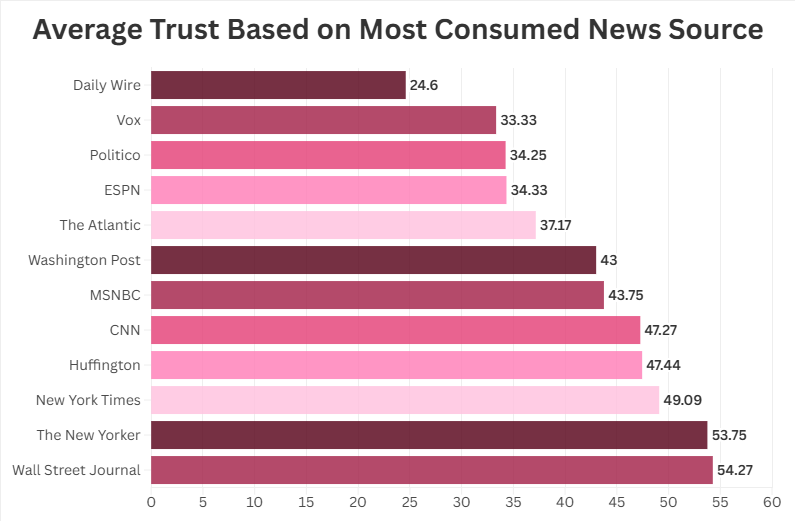
How does a student’s primary news source affect their trust in the news?
Next, we wanted to determine if there were news sources that were consumed and trusted the most by students. The data showed that a student’s primary news source plays a noticeable role in how much they trust the news overall. Students who rely on sources like The New Yorker, The Wall Street Journal, and The Huffington Post report some of the highest trust levels, landing in the upper 40s and low 50s. These outlets are often seen as more balanced or center-leaning in their reporting, which may explain the higher trust among their audiences. On the other end of the chart, students who mainly consume conservative outlets such as The Daily Wire show significantly lower trust, with averages in the mid-20s. Meanwhile, viewers of more liberal outlets, including CNN and MSNBC fall in the middle, but still report greater trust than the most conservative group. Overall, the pattern suggests that students who engage with more traditional or center-leaning news sources tend to feel more confident in the news, while those who follow extremely partisan outlets, especially conservative ones, tend to be more skeptical.
How does political affiliation affect how BYUI students view the news?
We then set out to find if political affiliation truly affects how much BYU-Idaho students trust the news. We chose to create a bar graph with the data comparing how they rank themselves based on political affiliation and how much they trust the news. It is clear in the graph that most progressive students barely put any trust in the news, as there was no data to suggest that they do. But the more moderate/centrist students put much more trust in it, matching up trust levels with those who are on the more conservative side. Those who are most conservative have the most trust in what the news outlets are telling them. This data shows that news outlets may be leaning more conservative rather than progressive, because conservative students are pleased with the news that they are hearing. Overall, the majority of BYU-Idaho students are conservative and put trust in the news because of it.

How often do BYUI students read news sources that disagree with their political views?
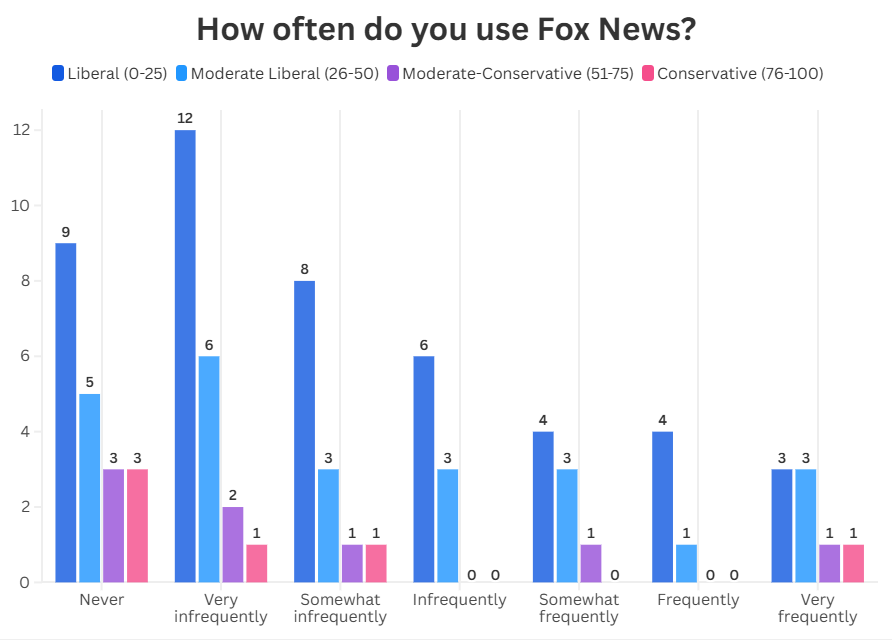
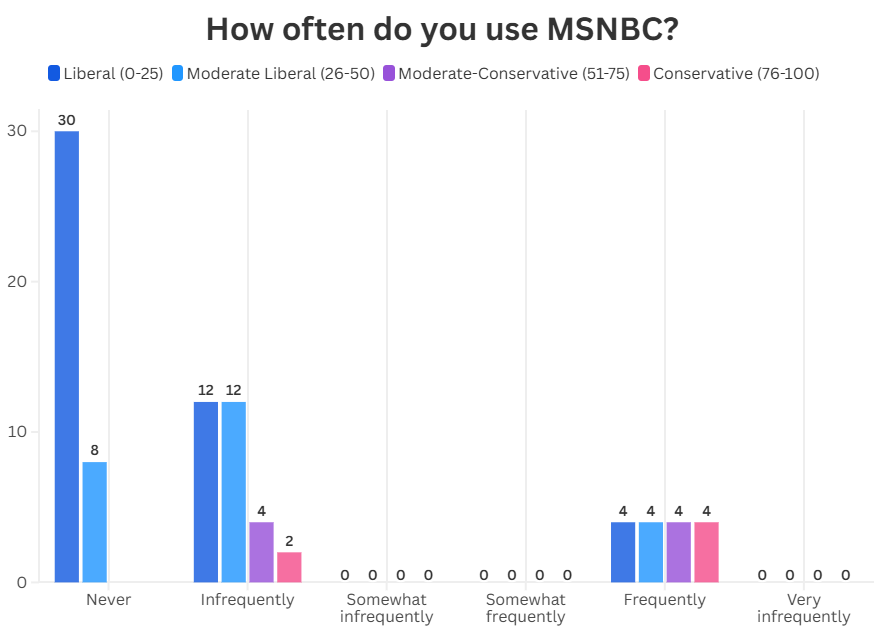
We wanted to know how often BYU-Idaho students use news sources that disagree with their political beliefs. We started by grouping the responses to political affiliation into categories- liberal is anyone who chose numbers 0-25 on the slider, moderate-liberal is anyone who chose numbers 26-50 on the slider, moderate-conservative is 51-75 on the slider, and finally conservative is numbers 76-100. Then we chose to compare those students’ usage of two news sources- MSNBC, which is considered a liberal source, and Fox News, which is considered a conservative source. The data shows that regardless of political affiliation, BYUI students never or very infrequently use Fox News. Less than 5 people for each affiliation said they frequently use MSNBC, but almost 30 of those who said they are liberal said they never use MSNBC. This is fascinating because MSNBC is seen as a liberal source, which makes us wonder what they are using instead.
How do students view protesting based on their news bias?
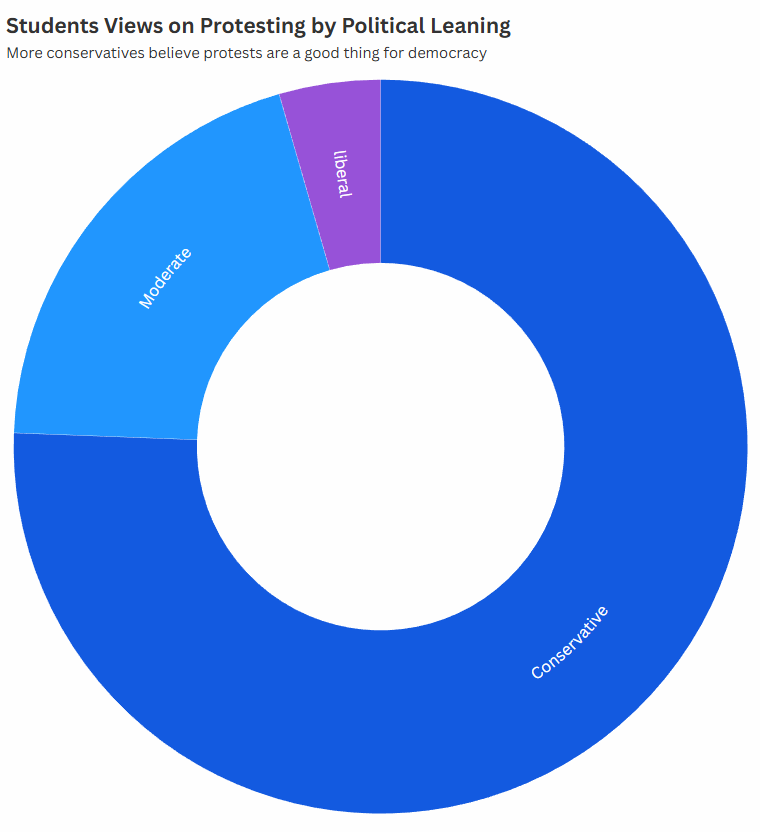
Here, our group set out to discover how students viewed protesting. The data revealed a stark divide in how students view the role of protesting in a democracy, and those differences closely follow political identity. Liberal students were the least supportive of protests, with an average score of 1.66, indicating more skepticism about how protests strengthen democracy. Moderate students’ score of 2.79 reflected mixed feelings about how good protests are for a democracy. Conservative students had the highest rating at 4.09, suggesting they believe protests are a good thing for democracy. This leads us to believe conservative students may view protests as an essential practice of free speech, while liberal students may question the overall effectiveness. This is especially interesting as it goes against what we see in practice, as conservative voters are less likely to participate in protests than liberal voters. Overall, the findings highlight how political leanings can shape a student’s view of public protests.
So what does this all mean?
In summary, there are several strong relationships between news consumption, political affiliation, and trust in the news. Political beliefs do affect how BYU-Idaho students consume and trust the news. If you consume news, you trust it, and if you don’t consume it, you don’t trust it. Additionally, conservative leaning students tend to trust the news more than liberal students. We note that BYUI students tend to trust and consume the more moderate news sources and very seldom use the far-leaning news sources on either side, regardless of their personal political beliefs. Those who are conservative tend to think protesting is good and helpful, while those who are liberal think the opposite. Most interesting was the data showing the most trusted news source, which was the Wall Street Journal and the New Yorker, because it is on the opposite side of the country from Rexburg, Idaho.
These findings line up with broader trends in national views on news. After researching many academic journals with related questions, we determined the greatest factors that affect trust in the news are characteristics like race, gender, religion, or political affiliation. Future research could be done about why students trust the Wall Street Journal and The New Yorker more than other sources, especially those who identify on the same side of the political spectrum. There is more to be learned about how socioeconomics plays a part in both what political affiliation people self-identify with and how that affects their news consumption.